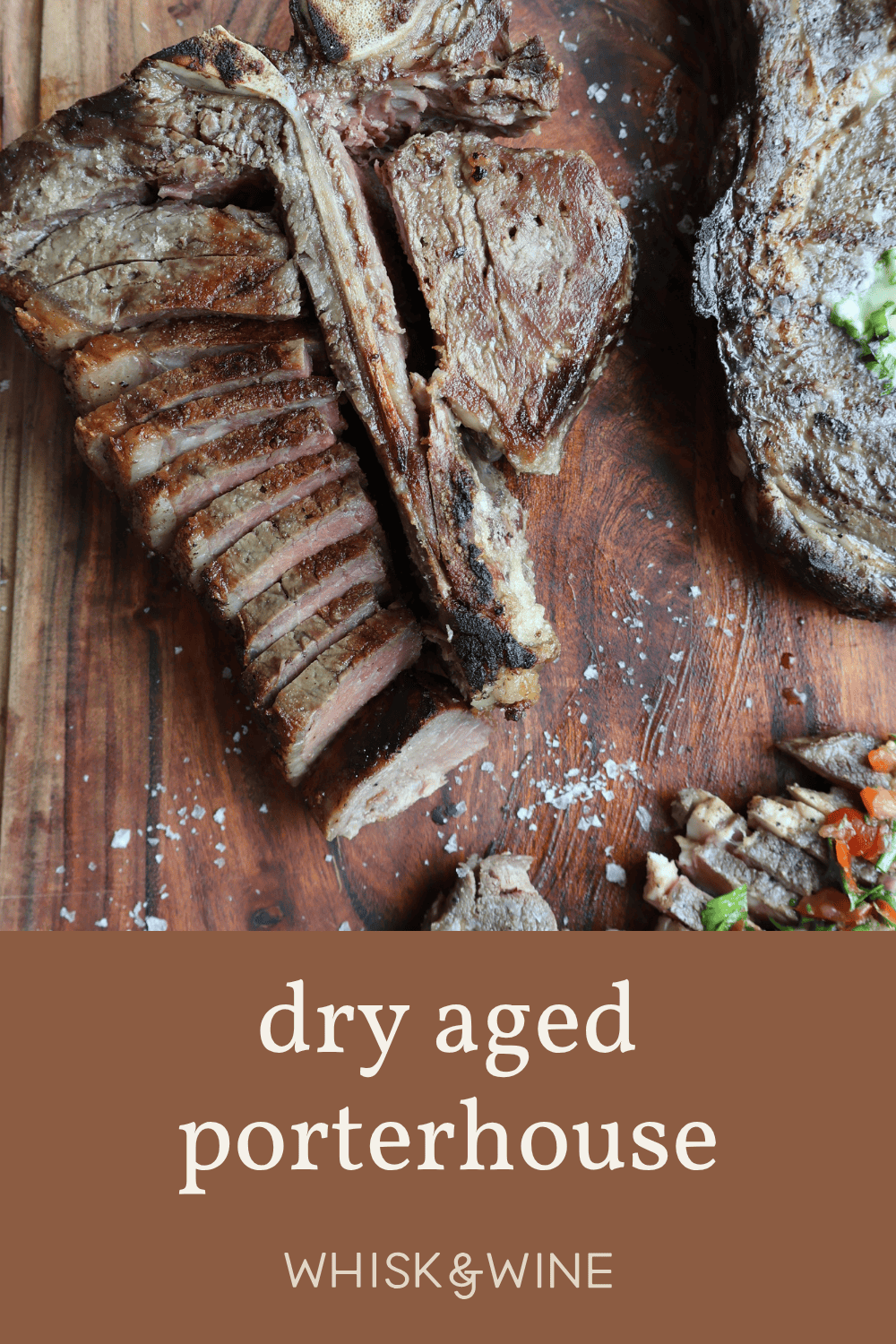
Dry Aged Porterhouse. Vintage Vibes. Grill Ready.
Fresh from the butcher counter to the beach house kitchen - a hand-selected, bone-in dry aged porterhouse, cut thick for the cast iron. The flavor is older, deeper, more itself. The cook is simple. The night is the kind that ends with the board passed around and the bone picked clean.

A porterhouse is two of the steakhouse's best cuts on one bone. A New York strip on the wide side of the T, a tenderloin on the narrow. One carve, two textures. The strip is rich and chewy with the deep, almost-cheesy minerality only long-aged beef carries. The tenderloin is soft and quiet, leaning into the flake salt at the end. Together, dinner.
The cut asks for almost nothing in return. Kosher salt the night before. A low oven. A rip-hot cast iron pan. A finishing flake at the table. Two ingredients, one bone, four moves. The dry age already did the seasoning work.
Watch the full reel on Instagram → @whisk__and_wine
Jump to:
Why You'll Love This Dry Aged Porterhouse
- Two cuts on one bone - a New York strip and a tenderloin from the same carve.
- Hand-selected, 28-day dry aged from the Pine Avenue counter.
- A two-ingredient cook - kosher salt and a hot cast iron pan.
- Steakhouse-quality crust without leaving the island.
- The thermometer does the math. You handle the salt.
- Built for Saturday night on the deck.
Dry Aged Porterhouse Ingredients
Two ingredients on the counter. Pick them both well.
- 3-inch dry aged bone-in porterhouse steak (28-day age minimum, longer if your butcher will let you wait)
- Kosher salt for the dry brine
- Florida Pure Sea Salt Pure Flaked (finishing salt)
Dry Aged Porterhouse Reverse Sear Time & Temp Calculator
Thicker cuts cook longer. Cast iron carries more carryover than a grill. The calculator below trades the math for a pull temp and a sear window - set your thickness, choose your doneness, get back to your drink.
Find Your Cook Time
Set thickness and target doneness. The calculator returns oven cook time at 225°F, the pull temp, your tented rest, cast iron sear time per side, and the final internal after carryover.
Why a 3-inch porterhouse needs the oven first
A 3″ bone-in porterhouse holds two cuts at once — strip on one side of the T-bone, tenderloin on the other — and the bone runs cool. Try to bring that mass up to temperature on a screaming-hot skillet and the exterior is leather before the center sees 100°F. Reverse the order. Hold 225°F low and slow until the center hits 105°F, then send the steak to a ripping-hot cast iron pan for one minute per side. Even cook from the oven, hard crust from the iron. The strip and tenderloin finish at the same temperature because the heat had time to equalize on the way up.
Oven cook time at 225°F (slow phase, pull at target temp)
| Thickness | Time to 95°F (rare) | Time to 105°F (med rare) | Time to 115°F (med) | Time to 125°F (med well) |
|---|---|---|---|---|
| 1.5″ | 30–45 min | 40–55 min | 50–65 min | 60–75 min |
| 1.75″ | 40–55 min | 45–65 min | 55–75 min | 65–85 min |
| 2″ | 45–65 min | 55–75 min | 65–85 min | 75–95 min |
| 2.25″ | 55–75 min | 65–85 min | 75–95 min | 85–105 min |
| 2.5″ | 60–85 min | 70–95 min | 80–105 min | 95–115 min |
| 2.75″ | 70–95 min | 80–105 min | 90–115 min | 105–125 min |
| 3″ (this recipe) | 75–100 min | 90–120 min | 100–130 min | 115–140 min |
| 3.25″ | 85–110 min | 100–130 min | 115–145 min | 130–160 min |
| 3.5″ | 95–120 min | 110–145 min | 125–160 min | 145–175 min |
Doneness chart (pull temp → final after carryover, cast iron sear)
| Doneness | Pull at | + Tented rest (10 min) | + Cast iron sear (60 sec/side) | Final after 8–10 min rest |
|---|---|---|---|---|
| Rare | 95°F | +3–5°F | +15–20°F | 118–122°F |
| Medium Rare | 105°F | +3–5°F | +15–20°F | 125–130°F |
| Medium | 115°F | +3–5°F | +15–20°F | 135–140°F |
| Medium Well | 125°F | +3–5°F | +15–20°F | 145–150°F |
USDA recommends 145°F internal for whole-cut beef. Medium rare at 125–130°F is a culinary standard for prime, dry-aged cuts. Pregnant, immunocompromised, very young, or elderly diners should cook to 145°F.
How to Reverse Sear a Dry Aged Porterhouse
Salt the night before. Low oven, then cast iron, then rest. Four moves. One bone. One probe.
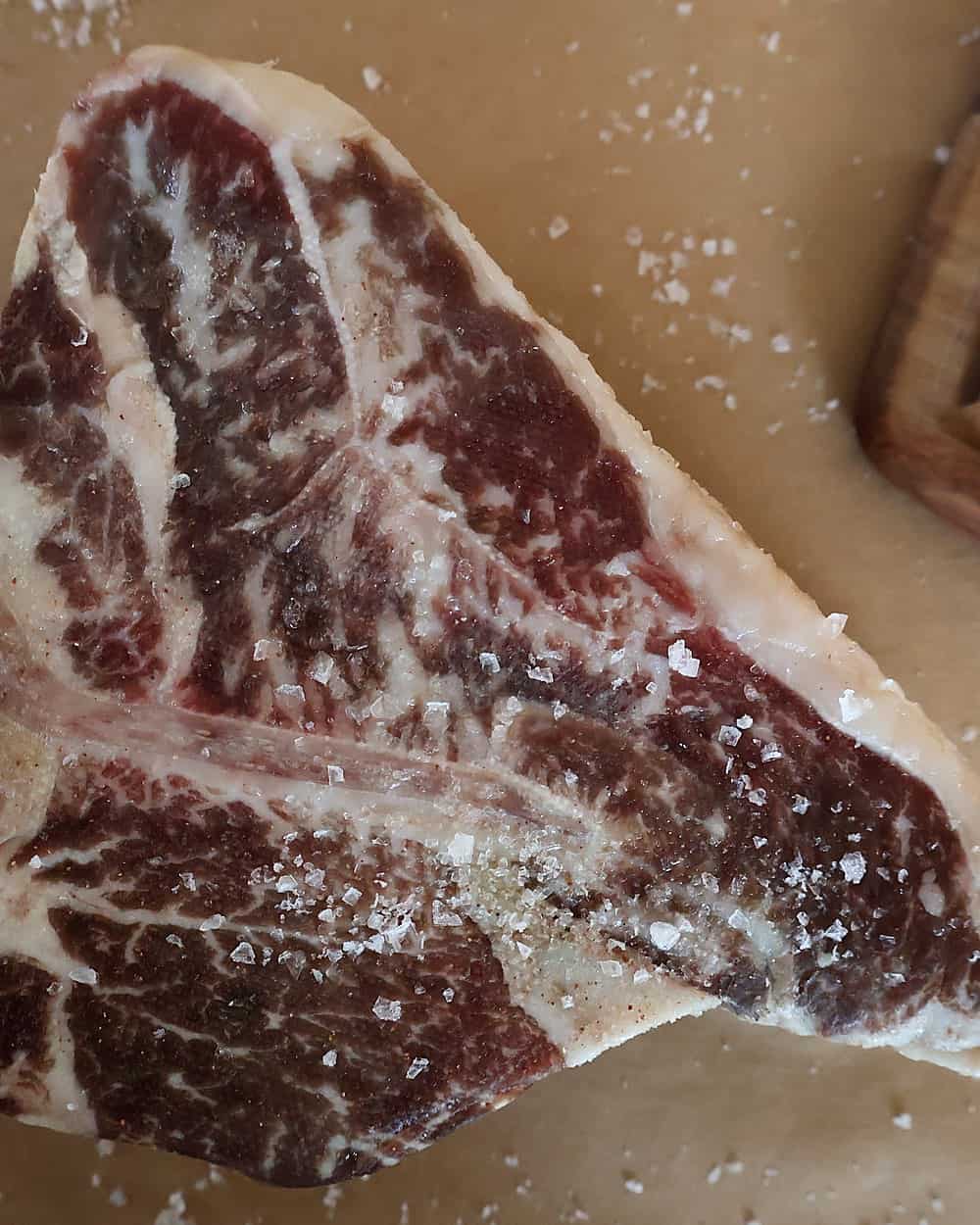
Dry brine the night before
Pat the porterhouse dry. Season heavily with kosher salt on every face - strip side, tenderloin side, the fat cap, around the bone. Set the steak on a wire rack over a rimmed sheet pan and slide it into the fridge, uncovered, for 12 to 24 hours. The salt opens the cut, then re-settles in. The surface dries into the kind of skin that browns hard the moment it meets the pan.
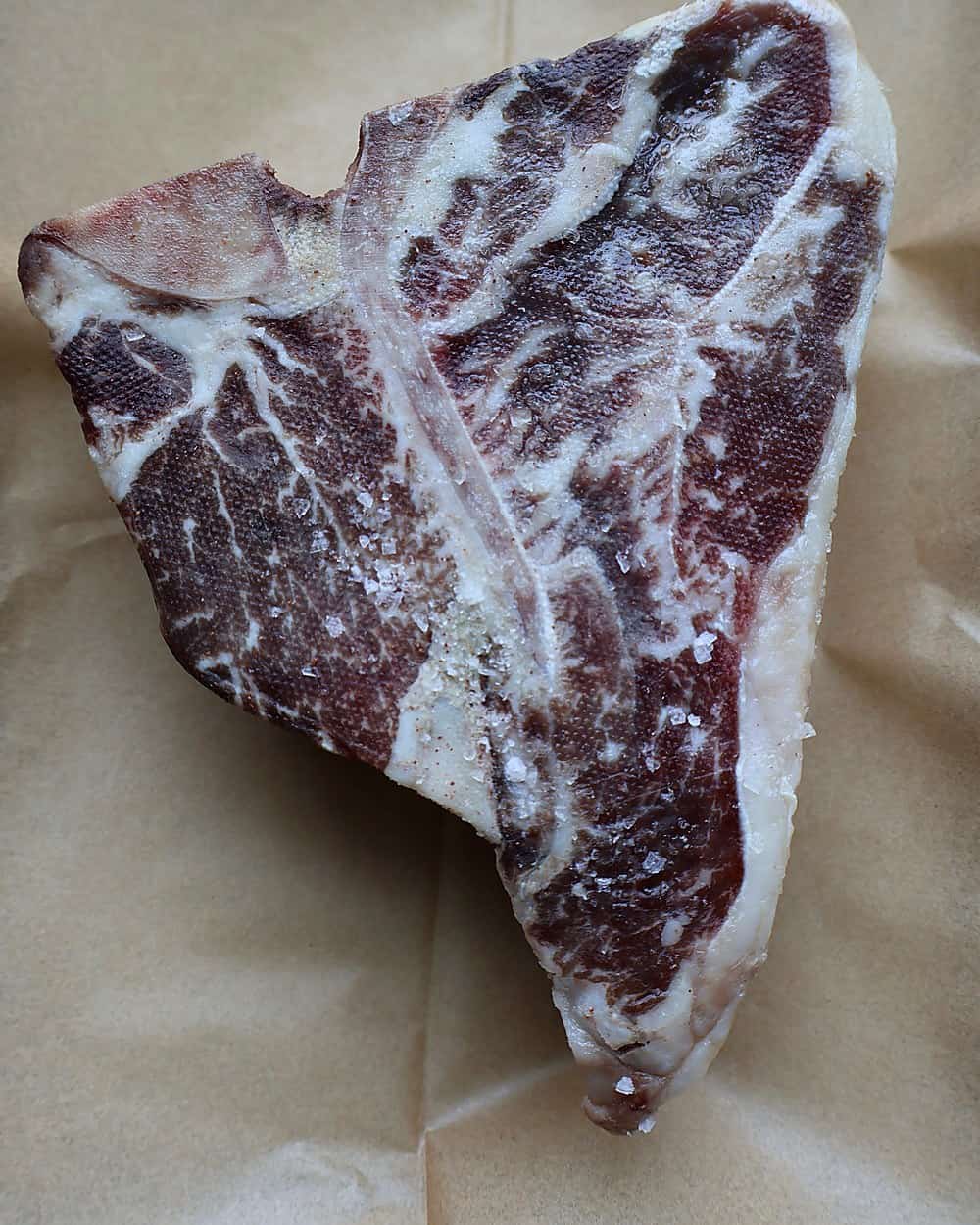
Slow oven to 105°F, then tented rest while the pan heats
Pull the porterhouse from the fridge an hour before you cook so the chill lifts. Heat the oven to 225°F. Set the steak on a wire rack over a sheet pan, slide it in with a leave-in probe planted in the thickest part of the strip, and walk away.
Pull when the probe reads 105°F. Move the steak to a cutting board, tent loosely with foil, and let it rest while the cast iron comes up to temp. The slow oven brought the inside even, edge to edge. The pan handles what's left.
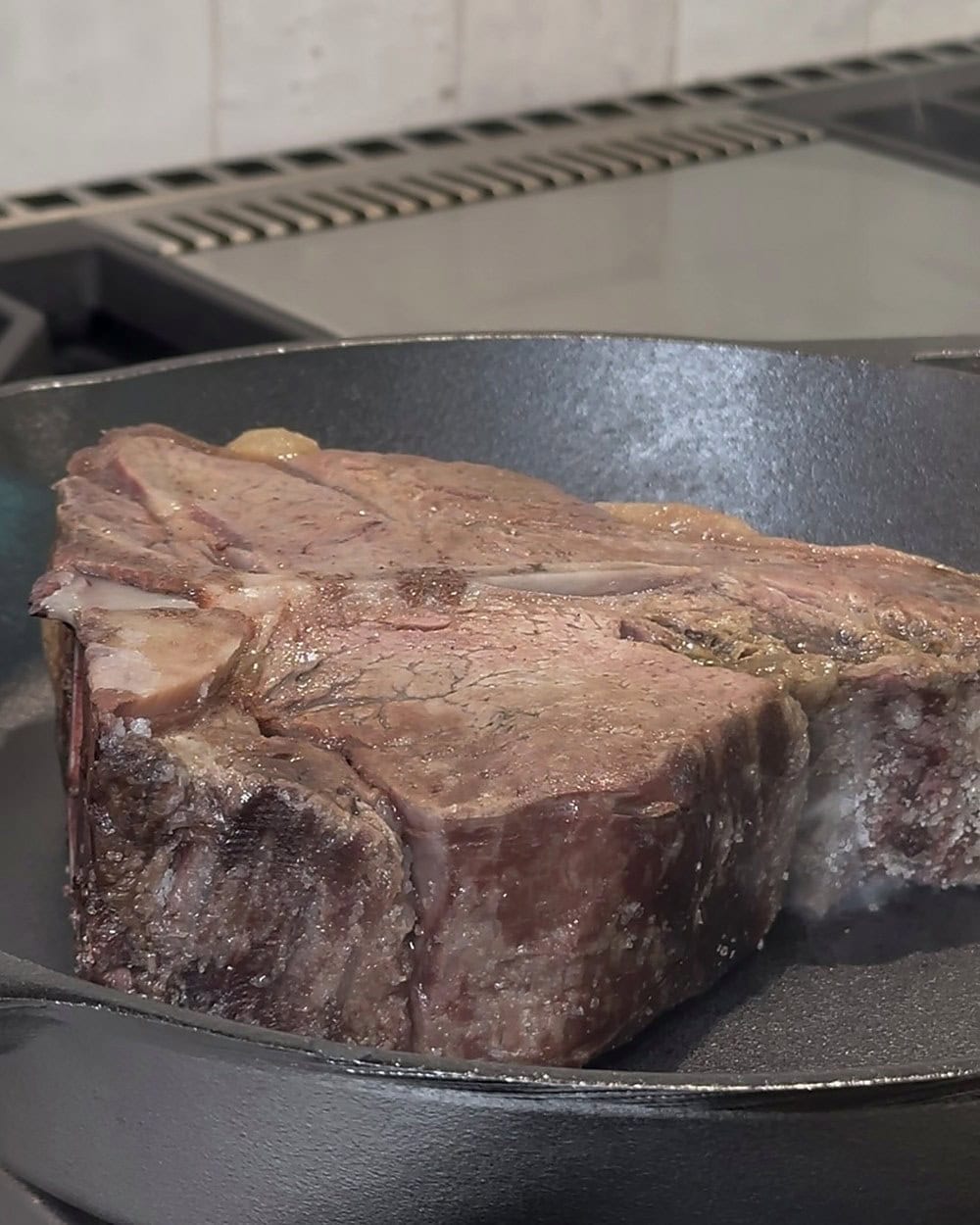
Cast iron sear, 60 seconds per side
Get the cast iron screaming hot - heavy smoke curling off the pan, just shy of blue. Lay the porterhouse in. Sixty seconds. Flip with long tongs. Sixty seconds. Stand the fat cap against the wall of the pan for another thirty. The bark goes deep brown, the crust whispers. Lift the steak out before it can do any more.
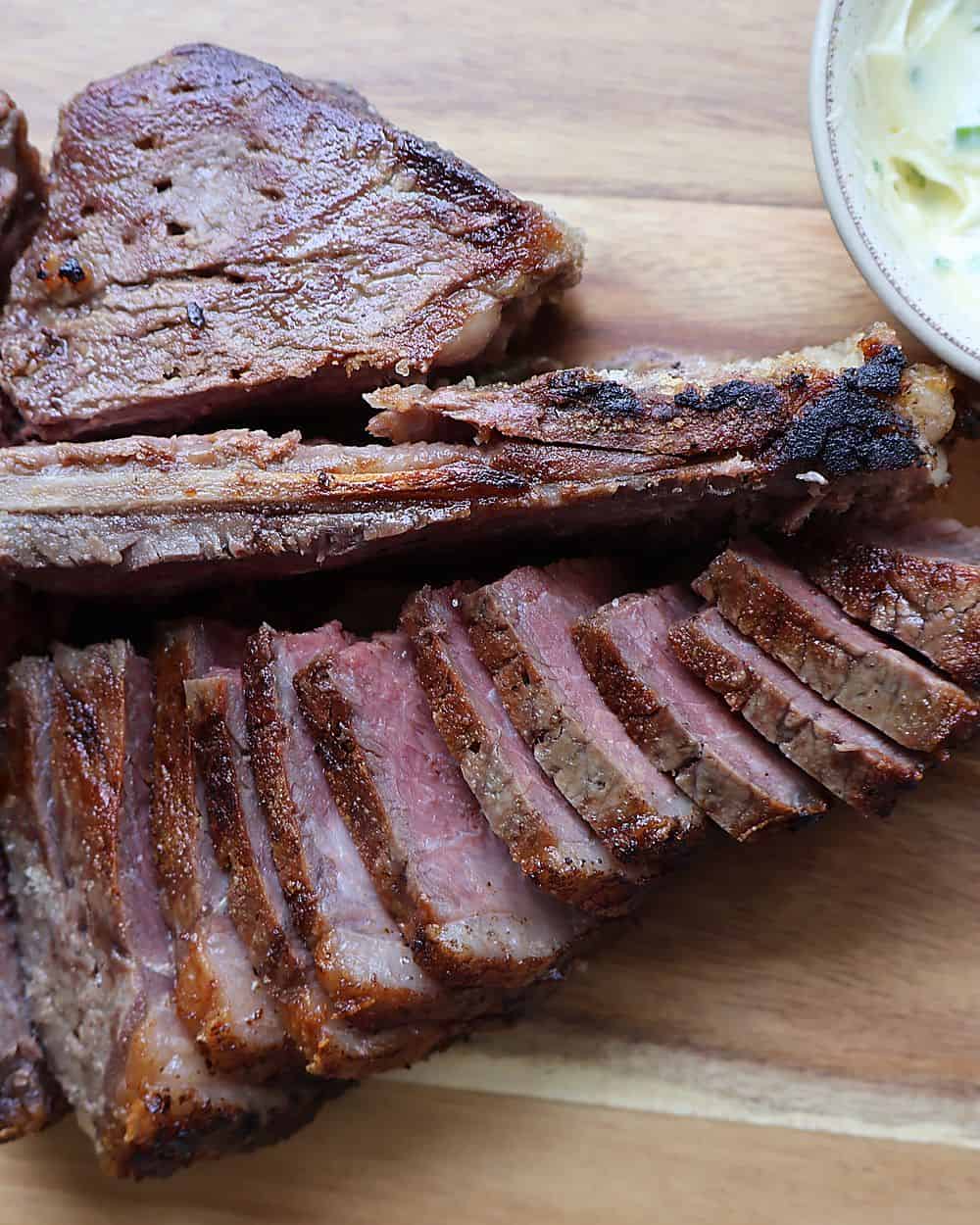
Rest, salt, slice (and pepper, if you want it)
Move the porterhouse back to the cutting board and rest it eight to ten minutes - long enough for the juices to settle, short enough to keep the crust crackling.
If you want pepper, it goes on now. Cracked coarse, after the sear, never before - black pepper burns the moment it hits a cast iron that hot.
Run a knife along the bone. The strip lifts off in one piece, the tenderloin lifts off the other. Slice each across the grain into thick coins and shower the platter with Florida Pure Sea Salt flake. Plate over a smear of Cow's Rule Bleu Cheese & Chive compound butter and let it melt into the meat as the board hits the table.
Substitutions
Two ingredients in. Both swappable, neither necessary to swap.
- Brining salt. Kosher is the standard - Diamond Crystal if you have it, Morton's if you don't (use less by volume; the crystals pack heavier). Skip table salt and fine sea salt - the small grains over-season and disappear into the cut.
- Finishing salt. Florida Pure Sea Salt Pure Flaked is the pick. Maldon is the easy backup. Anything ground or pre-ground misses the texture moment at the table.
- The cut. A dry-aged T-bone works the same way with a shorter rest. A wet-aged porterhouse takes the same method, just trades some of the dry-age depth for the cleaner, sweeter beefiness of a fresh-cut steak.
- The pan. Heavy carbon steel works. A standard non-stick won't get hot enough and won't crust. Cast iron is the standard for a reason - and a 12-inch pan is the size.
Variations
One cut, several finishes. Pick whatever fits the table - a quiet Sunday at the counter or a full house after a day on the water.
- Sunset on the deck. Plate over a smear of Cow's Rule Bleu Cheese & Chive compound butter. Add garlic confit cloves and a drizzle of the confit oil. Finish with lemon and orange zest, pass the board around.
- Surf and turf. A few peeled Gulf shrimp dropped into the cast iron after the sear, two minutes a side in the rendered fat. Pile on top of the carved steak.
- Citrus and herb. Microplane lemon and orange zest across the top right before serving. The acid cuts the dry-age funk; the orange brings a softer sweetness in behind it.
- Steak frites, beach edition. Twice-fried potatoes, flaky salt, a wedge of lemon. The porterhouse sliced down the middle of the platter.
- Dock lunch the next day. Cold porterhouse on grilled bread with horseradish cream and a few cornichons. The flavor deepens overnight in the fridge.
Storage
Wrapped tight in foil, the porterhouse keeps four days in the coldest part of the fridge - the cold sliced beef gets better through day two. Warm slices low and slow in a 200°F oven, fifteen minutes, just to take the chill off. Or eat them cold the next day on the dock with mustard and a stack of buttered bread.
Top Tip - Trust the probe, ignore the timer
A 3-inch dry aged porterhouse is a thermometer cook, not a clock cook. The 90-to-120-minute oven window is a guide; 105°F at the strip is the actual cook. Pull when the probe says pull. Cast iron lands the rest.
Dry age handles the seasoning. The thermometer handles the cook.
A porterhouse is a thick bone-in steak cut from the rear of the short loin - a New York strip on the wide side of the T-bone, a tenderloin on the narrow. Dry aging holds the cut in a temperature- and humidity-controlled case for 28 days or more. The water leaves, the flavor stays, and the beef takes on a deeper, more mineral, slightly funkier edge. The bark dries hard on the outside; the butcher trims it off; what reaches your kitchen is a more concentrated version of the same cut.
Cast iron carries more carryover than a grill. A rip-hot skillet adds 15 to 20°F to a steak in two minutes; a grill in the same window adds 10 to 15°F. Pulling at 105°F lets the cast iron do its work and still lands you at the medium-rare you wanted. If you switch to a grill finish, raise the pull to 115°F.
Yes - and for a thicker porterhouse, a two-zone grill is the cleanest finish. Slow side at 225°F to 105°F, hot side over live coals for two minutes a side. The geometry of the porterhouse is awkward in a pan; an open flame handles the strip and the tenderloin more evenly. If the beach rental doesn't have a grill, the cast iron path works. Just pull at 105°F.
A 3-inch porterhouse weighs around 2 to 2.5 pounds on the bone and serves three to four. Cut the strip and tenderloin off the bone, slice each across the grain into thick coins, and the platter goes around the table once for steak and a second time for whoever wants more. Plan a side of potatoes and a green for the rest of the dinner - the porterhouse is the headline.
📖 Recipe
Dry Aged Porterhouse Steak (Reverse Sear, Cast Iron Crust)
- Total Time: 14 hours 25 mins
- Yield: 1 porterhouse (serves 3-4) 1x
Description
A 3-inch dry-aged porterhouse, reverse seared at 225°F to 105°F internal, finished in a screaming-hot cast iron skillet for 60 seconds per side. Two cuts on one bone - strip on the wide side, tenderloin on the narrow - and a hard crust over edge-to-edge medium rare interior.
Ingredients
 Get Recipe Ingredients
Instructions
- Pat the porterhouse dry with paper towels.
- Season the steak heavily with 2 tablespoons kosher salt on every face - strip side, tenderloin side, fat cap, around the bone.
- Place the steak on a wire rack over a rimmed sheet pan. Refrigerate uncovered for 12 to 24 hours.
- Remove the steak from the fridge 1 hour before cooking. Heat the oven to 225°F.
- Insert a leave-in probe thermometer into the thickest part of the strip, away from the bone.
- Place the porterhouse on the wire rack in the oven. Cook until the probe reads 105°F internal, about 90 to 120 minutes.
- Pull the steak. Tent loosely with foil and rest 10 minutes.
- While the steak rests, heat a heavy 12-inch cast iron skillet over high heat for 10 minutes - pan should be visibly smoking.
- Press the porterhouse into the dry, smoking pan. Sear 60 seconds. Flip with long tongs and sear 60 seconds on the second face.
- Tip the steak onto each edge for 20 to 30 seconds - bone side, then each fat cap.
- Move the steak back to the cutting board. Rest 8 to 10 minutes.
- Sprinkle 1 teaspoon Florida Pure Sea Salt Pure Flaked across the top. If using pepper, add a coarse grind now - never before the sear, where it would burn on the cast iron.
- Run a knife along the bone to lift off the strip and tenderloin in one piece each. Slice both against the grain into ½-inch pieces. Serve with extra flaky salt at the table.
Notes
The probe is the recipe. A 3-inch dry-aged porterhouse is a thermometer cook, not a clock cook. Pull at 105°F when the probe reads it, regardless of minutes elapsed. Carryover from the cast iron sear and the final rest adds 18 to 25°F - final lands at 125 to 130°F medium rare.
Cast iron vs grill. If you're searing on a grill instead of cast iron, raise the pull temp to 115°F. A grill at the same time adds 10 to 15°F of carryover; cast iron adds 15 to 20°F.
Compound butter (optional). A pat of Cow's Rule Bleu Cheese & Chive Compound Butter melted onto the strip side as the steak rests is the steakhouse-plate finish. Au Poivre is the alternate.
Pepper goes ON AFTER the sear, never before. Cracked black pepper hits a smoking cast iron pan and turns acrid in seconds. Added on the cutting board after the rest it stays sharp, floral, and clean.
- Prep Time: 5 mins
- Cook Time: 2 hours
- Category: Dinner
- Method: Reverse Sear
- Cuisine: American